
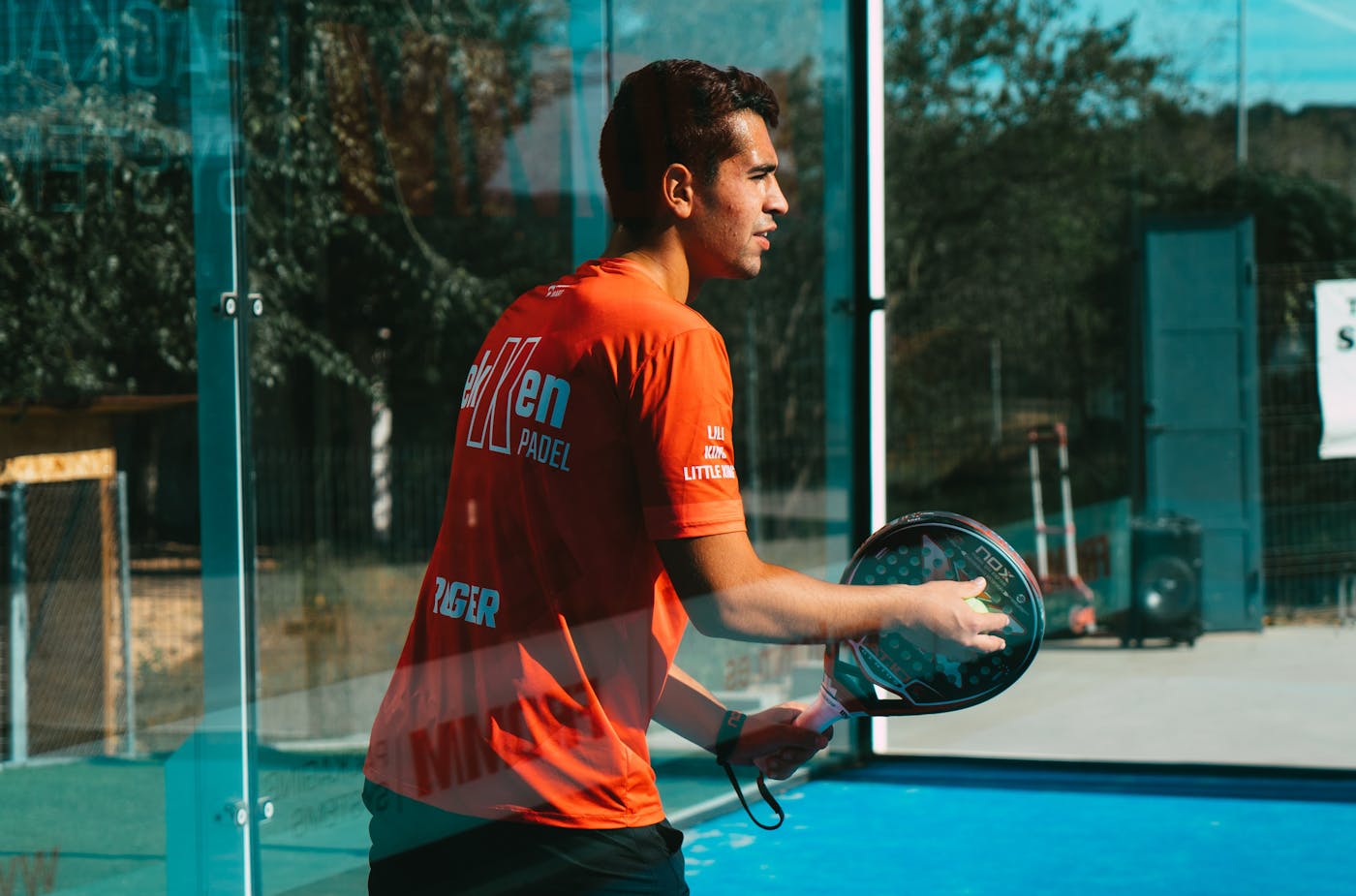
To practise a deeper padel volley, use a predictable partner feed and aim for a controlled first bounce beyond the opponents’ service line. Once that is manageable, add movement and then a live rally. This guide is for players who can already volley over the net and want to improve placement without simply swinging harder.
A volley is a shot hit before the ball bounces. Here, deep means the ball’s first bounce lands beyond the service line in the opponents’ half, without hitting their wall or fence first. LTA Padel uses a similar depth target in its volley practice guidance. The practice plan below is an editorial exercise, not a measured training study.
Set up the target
One player starts at a comfortable net position; their partner feeds from the opposite half. Choose a broad area between the service line and the back wall, leaving space from both side walls. Use flat markers outside active footpaths or agree the area by sight. Warm up first with the 12-minute padel routine.
The feeder starts each attempt gently towards the volleyer’s comfortable forehand. A successful attempt clears the net and first bounces in the agreed deep area. A shot into the net, outside the court, or directly into the opponents’ wall does not count as a success. Count every playable feed as an attempt, including misses. Stop a feed if another player or ball enters the space.
Three stages, one scorecard
| Stage | Feed and task | Record |
|---|---|---|
| 1. Predictable | Feed 10 similar balls to one side. Volley towards the deep target and reset after each shot. | Successful deep bounces out of 10. |
| 2. Move and recover | Feed 10 balls alternately to forehand and backhand, at a pace that allows the player to move. Recover to ready position between shots. | Deep bounces out of 10 and whether you felt balanced. |
| 3. Continue the rally | Start each of 10 attempts with a feed, then play a short live rally. Count only the first volley against the same target. | Deep first volleys out of 10. |
Swap roles after a set. Treat the counts as your own practice notes, not a ranking of players or proof of match improvement. For example, if stage 1 is 7/10 but stage 2 is 3/10, try slower alternating feeds or smaller changes in direction. If stage 2 feels controlled over two sets, move to stage 3; if it repeatedly feels rushed, return to stage 1. The numbers guide your next practice choice rather than serving as a universal pass mark.
What should you focus on while volleying?
Prepare the racket early and use a short, controlled movement. On a faster ball, a compact block may be easier to direct; on a comfortable feed, use a controlled push. Aim with room over the net and inside the court. Depth is where the ball lands, not how hard you hit it.
If you are repeatedly hitting the net, pause the depth challenge and use the net-error diagnosis guide. If movement makes contact rushed, reduce the feed pace and revisit the split-step progression. A coach can help you adapt the drill to your level.
How do you take the drill into a match?
Try the target when a ball arrives at a comfortable height and you have time to prepare. A low or fast ball may call for a simpler defensive reply. When you have time and space in a rally, letting a ball bounce once is also an option; the return of serve must bounce before it is hit. See LTA Padel’s rules.
Afterwards, note one situation in which the deep volley felt available and one where it did not. The match review guide helps turn that observation into a next practice. You can also use Padel Coach App to review a suitable clip of your preparation and recovery; obtain permission from everyone recorded and follow venue rules, as explained in our recording guide.
Learn how our guides are researched, prepared and checked in our editorial policy.