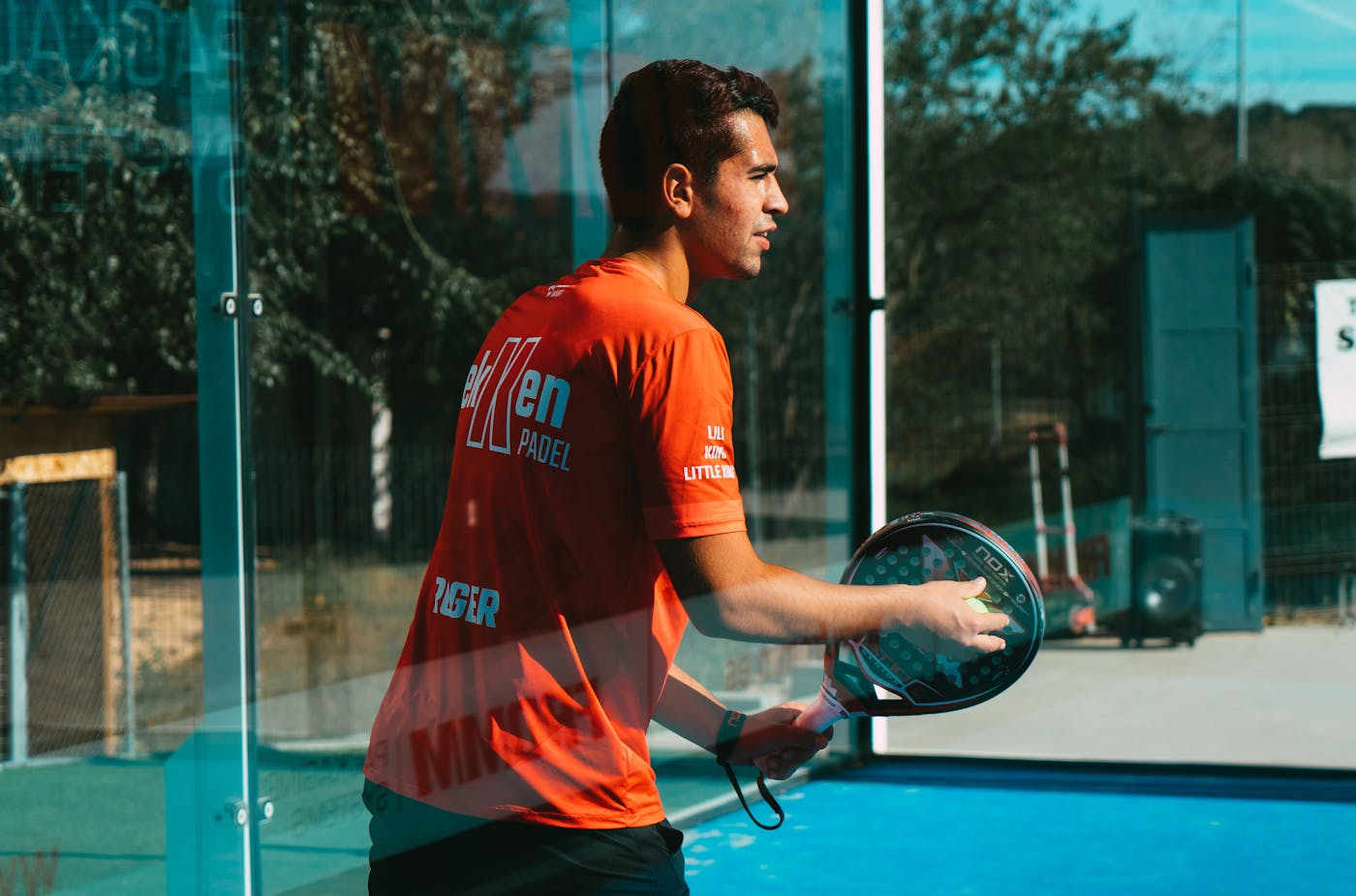
To use the back glass in padel, let the incoming ball bounce once on your side, allow it to rebound from the glass, and return it before it bounces on the floor a second time. Give the ball space, turn with its path, and make a compact swing after the rebound. The glass is not an obstacle to escape from; it gives you extra time when a deep ball would otherwise force a rushed contact.
The International Padel Federation’s 2026 rules confirm that a ball remains in play after bouncing in your court and then touching a wall. They also allow a return to hit a wall in your own court first, provided it then lands correctly in the opponents’ court. This guide focuses on the more common beginner skill: receiving a deep ball after it rebounds from your back glass.
When should you let the ball hit the back glass?
Use the glass when the ball lands deep enough that taking it before the wall would crowd your contact point or force you to hit while moving backwards. A slower, higher ball that will rebound away from the wall is often easier to play after the glass.
Consider playing the ball before the glass when it is short, comfortable and lets you stay balanced. There is no prize for using the wall on every deep shot. The decision is about which contact gives you more time and control.
A useful early cue is the first bounce:
- A deep bounce near the service line or behind it will often reach the back glass with useful energy.
- A shallow or dying ball may not rebound far enough to create space.
- Heavy spin can change the rebound, so watch the ball rather than assuming it will leave the wall at a matching angle.
If you are unsure, move early enough to keep both options available. Waiting motionless until the ball reaches the glass usually turns a helpful rebound into a late emergency.
Where should you stand?
Start in a balanced defensive position with room between you and the back glass. Standing against the wall leaves no space to read the rebound or swing. Standing too far forward can make a deep ball pass your ideal contact point before you can move with it.
The exact distance changes with the speed, height and spin of the shot. Use the service line as a visual reference rather than a rigid destination, then adjust with small steps. Our guide to padel positioning basics explains how your position should work with your partner’s rather than as an isolated spot.
As the ball travels towards you:
- Recognise early that it is likely to reach the glass.
- Turn your shoulders and move out of the ball’s path instead of backing straight into the wall.
- Let the ball pass beside you and rebound.
- Adjust so contact is in front of your body and away from the glass.
- Recover with your partner after the shot.
Think turn, move, wait, hit. Beginners often reverse the middle two steps: they wait first, then rush their feet after the rebound.
How should you swing after the rebound?
Use a compact preparation and a controlled low-to-high path. You are usually defending, so the goal is to regain time and court shape rather than produce a winner from beside the wall.
Let the rebound supply part of the ball’s pace. Keep your grip pressure comfortable, meet the ball in front, and finish in the direction of your target. A large backswing makes timing harder and increases the chance of contacting too close to your body.
Three sensible targets are:
- a high cross-court lob when you have enough balance and space;
- a lower ball through the middle to reduce the opponents’ angles;
- a controlled cross-court return when the straight lane is covered.
Choose the target from your contact quality. If you are late or stretched, height and margin matter more than disguise.
Common back-glass mistakes
Standing too close to the wall
This removes the very space the rebound is meant to create. Begin farther forward and move around the ball’s path.
Following the ball backwards
Retreating in a straight line can leave the ball directly behind you. Turn and move to the side so you can see the ball before and after it reaches the glass.
Hitting immediately after the rebound
You do not have to strike the instant the ball leaves the wall. When the pace allows, let it travel into a comfortable contact zone while staying aware that a second floor bounce ends the point.
Trying to attack from a defensive contact
A low ball behind your body is rarely the moment for a hard drive. Use height or the middle, recover your position, and build the rally again.
Watching the wall instead of the ball
The rebound changes with pace, spin and the angle of arrival. Keep your attention on the ball through contact with the glass.
A simple back-glass practice progression
Begin without scoring so the player can learn the flight rather than worry about winning the rally.
Stage 1: predictable feeds. A partner or coach feeds medium-paced balls that bounce deep and reach the centre of the back glass. The defender calls “glass” early, turns, moves and returns cross-court.
Stage 2: choose before or after. Mix shorter feeds with deeper ones. The defender must decide whether to play before the glass or let it rebound. This trains recognition, not just the stroke.
Stage 3: add a target. Place a safe target through the middle and a larger target for the lob. Award a point for a controlled return that lands in either area.
Stage 4: continue the rally. Feeders take the net and play out the point after the glass return. The defending pair must recover its shape together.
Record five to ten repetitions from behind or to the side of the court. Review where you were at the first bounce, whether you moved out of the ball’s path, and where contact occurred. The workflow in how to use AI video analysis for padel can help you turn one repeated issue into the next practice goal. You can then note the result using the same focused approach described in what to track after every padel match.
The LTA’s basic padel shot tutorials include demonstrations for both the back glass and double glass. Use a demonstration to understand the movement, then compare it with your own repeatable contact rather than trying to copy every detail at full speed.
Back-glass questions answered
Can the ball hit the glass after bouncing on my side?
Yes. After one floor bounce on your side, the ball can rebound from the back or side wall and remain in play. Return it before a second floor bounce.
Can I hit my own back glass to return the ball?
Yes. A return can hit a wall in your own court first and then travel over the net, but it still needs to land correctly in the opponents’ court. This defensive shot is often called a contrapared and is different from receiving a ball after it rebounds from the glass.
Can I hit my own metal fence first?
No. The FIP rules allow the ball to be played via your own wall, but a return that hits your own metallic fence before crossing is lost. Glass or another permitted wall surface and metal fencing are not interchangeable here.
Can the ball touch both the side and back glass?
Yes, after the ball has bounced on your side it can rebound from more than one permitted court surface before you return it, as long as you play it before the second floor bounce. The movement and reading are harder, so learn the single back-glass rebound first.
Make the glass buy you time
The most important change is often psychological: stop treating every ball behind the service line as something you must intercept. Read the depth, create room, and let the rebound bring a difficult ball back into a playable space.
In Padel Coach App, save one short back-glass clip and review the same three checkpoints each time: position at the bounce, movement around the ball, and contact after the rebound. One clear observation gives your next session a more useful focus than a long list of unrelated corrections. Browse the padel drill library when you are ready to connect that observation to structured practice.
Learn how our guides are researched, prepared and checked in our editorial policy.