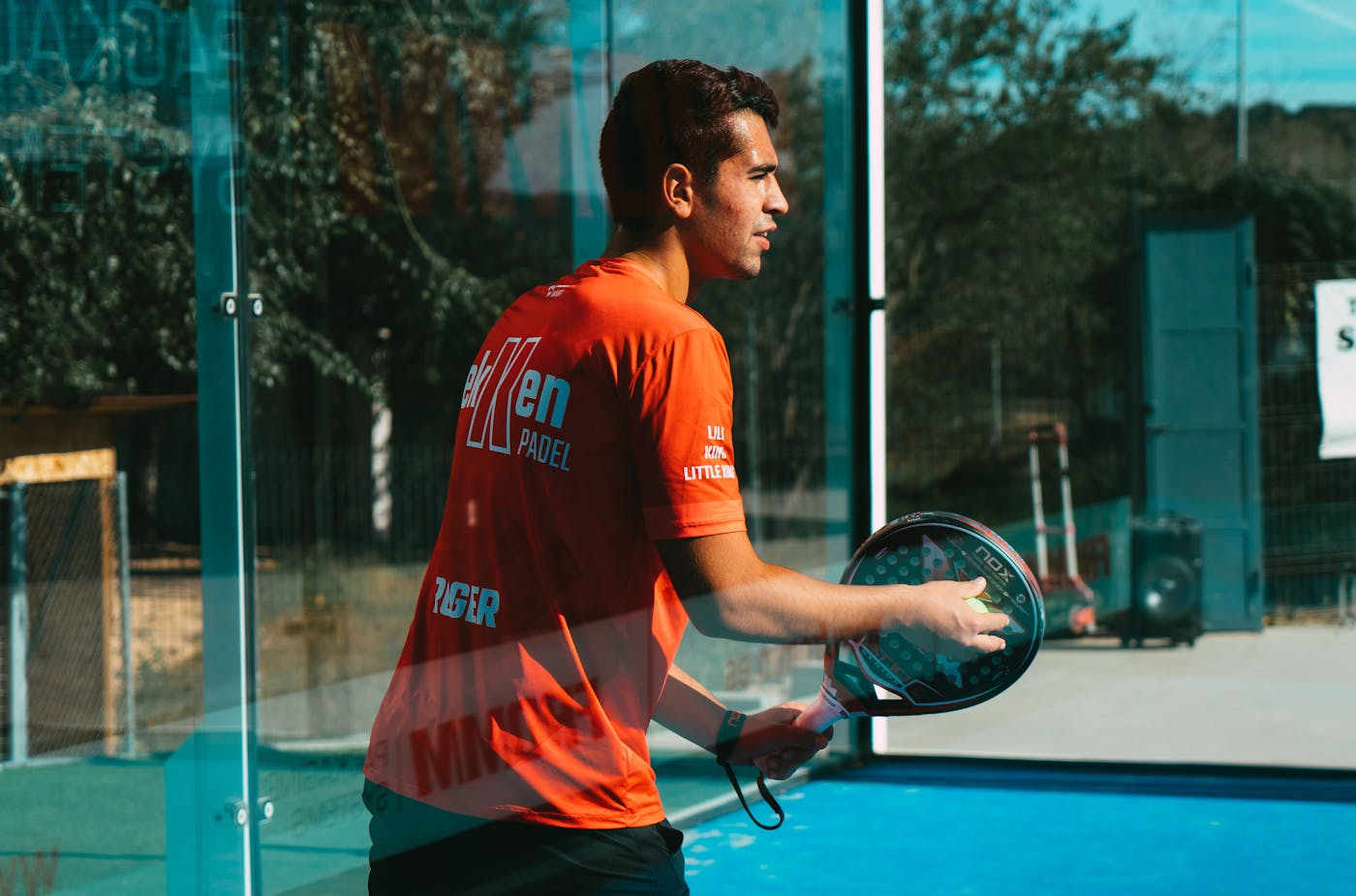
A legal padel serve starts with a bounce in your own service area. You must strike the ball at or below waist height, keep at least one foot on the ground, and send it diagonally into the opposite service box. A ball that lands on a service-box line is in. If your first serve is a fault, you normally have a second serve.
Those basics sound simple, but several details create arguments in club matches. This guide applies the International Padel Federation’s Rules of Padel effective from 1 January 2026 to the situations players encounter most often.
The quick legal-serve checklist
Before looking at the exceptions, check these five things:
- Start in the correct service area, behind the service line and between the centre-line extension and the side wall.
- Bounce the ball on the ground within that same area before striking it.
- Make contact at or below your waist, with at least one foot touching the ground.
- Serve diagonally over the net into the correct receiving box.
- Do not touch the service line, the imaginary centre-line extension or the receiving box on your side before contact.
The first point of a game is served from the right. The next point is served from the left, and the sides continue to alternate after every point.
Where exactly can the server stand?
At the start of the motion, the server stands behind the service line on the correct half of the court. One foot must be behind that line and inside the lateral limits created by the centre-line extension and side wall.
The common foot-fault mistakes are:
- stepping on or across the service line before hitting the ball;
- touching the imaginary extension of the centre service line;
- stepping into the other service half while serving;
- leaving the ground completely at contact.
You do not need to freeze your whole body. Keep your feet within the legal area and at least one foot in contact with the court when you strike the ball.
Does the ball have to bounce before a padel serve?
Yes. Unlike a tennis serve, you cannot hit the ball directly from a toss. The ball must bounce within your current service area before you hit it.
Control the bounce rather than dropping the ball from shoulder height. A repeatable release beside your front leg makes it easier to contact below the waist and direct the serve without rushing.
If you swing and miss while intentionally attempting to strike the ball, the rules treat that attempt as a serve and it is a fault.
How is waist height judged?
The ball must be at or below the server’s waist when racket contact occurs. The rule is about the height at contact—not where you released the ball or how high the racket finishes.
This is why a very high bounce can cause a fault even when the stroke looks underarm. If your contact regularly drifts upward, lower the release, let the ball settle into a predictable bounce and record the serve from the side. The workflow in our guide to using AI video analysis for padel can help you compare contact height across several attempts.
Where must a legal padel serve land?
The serve travels diagonally into the receiver’s service box. The first bounce must be inside that box or on one of its boundary lines. Under the FIP rules, the lines count as good.
After the first bounce:
- If the ball then touches the metal fence before its second bounce, the serve is a fault.
- If it reaches the glass after landing correctly, it is not automatically a fault; the receiver can play it before the second bounce.
- On a court without an authorized safety area, a serve that bounces in and then exits directly through a gate is a fault.
For most players, a controlled serve that stays low after the glass is more useful than chasing an ace. It can make the return awkward while still giving you time to move forward with your partner. Practise that movement with the return and first volley drill.
Is it a let if the serve clips the net?
It depends on what happens next.
The serve is a net and is repeated when it touches the net or supporting post, then lands in the correct service box without touching the metal fence before the second bounce. If this happens on a first serve, the server begins the point again with two serves. If it happens on a second serve, only the second serve is repeated.
If the ball clips the net but lands outside the correct box, it is a fault rather than a let. The same applies if it lands correctly and then touches the metal fence before the second bounce.
The LTA’s 2026 referee and competition-organiser guide also describes the normal service-let rule: a serve that clips the net and lands correctly is replayed.
What must the receiver do?
The receiver must let the served ball bounce in the service box before returning it. Volleying a serve is not allowed. If the serve hits the receiver or the receiver’s racket before it bounces, the server wins the point.
The receiving pair chooses its receiving order in the first game of each set and then alternates receivers throughout the set. The order can be changed at the beginning of a new set, but not midway through the current one.
Strong returning begins with position and spacing, not simply reaction speed. Review our padel positioning basics before practising serve returns as a pair.
Who serves, and when can the order change?
Before each set, a pair decides which partner will serve first. Once that order is established, the partners alternate service games in the same order for the rest of the set. They can choose a different order at the beginning of the next set.
If someone serves from the wrong side, correct the position as soon as the mistake is discovered. Points already completed remain valid. The same general principle applies when a player serves out of turn: correct the order when discovered, while retaining completed points.
Does Star Point change the serve itself?
No. The 2026 FIP rules list advantage, Star Point and Golden Point as scoring options. Star Point introduces a deciding point after a defined sequence of deuces and advantages; the receiving pair chooses the receiving side for that deciding point. It does not change the bounce, waist-height, foot-position or diagonal-box requirements of the serve.
Competition organisers must make the scoring format clear. Do not assume that every social match, league or tournament is using Star Point simply because it appears in the current FIP rules.
A simple serve-and-transition practice
Use ten balls from each service side:
- Place a target deep in the receiver’s box, away from the metal fence.
- Record from the side so your contact height and feet are visible.
- Serve at 70% pace and recover toward your normal net position.
- Score one point for a legal serve and one for reaching a balanced first-volley position.
- Review misses by type: foot fault, high contact, wrong box, fence after bounce or tactical miss.
The two-part score stops practice becoming a serving contest. In padel, the serve creates the next ball; it rarely ends the rally by itself. Log the pattern after your session using the principles in what to track after every padel match, or use Padel Coach App to keep the video review, training focus and progress notes together.
Padel serve rules: quick answers
Can I serve overarm in padel?
No conventional overarm tennis serve is legal. The ball must bounce first and be struck at or below waist height.
Is a serve on the line in or out?
In. The lines surrounding the receiving service box count as good.
Can a padel serve hit the glass?
Yes, after it first bounces legally in the receiving box. A ball that touches the metal fence before its second bounce is different: that is a service fault.
Do I get two serves?
Yes. If the first serve is invalid, you have a second serve. Two consecutive faults lose the point.
Can the receiver volley the serve?
No. The receiver must allow the serve to bounce in the receiving box before returning it.
Official sources
- International Padel Federation: Rules of Padel, application from 1 January 2026
- International Padel Federation: official documents library
- LTA Padel Referee and Organiser Guide 2026
Learn how our guides are researched, prepared and checked in our editorial policy.